GptZero Review - Ratings & Features (2024)
GPTZero emerged as a revolutionary AI detector, distinguishing itself as the vanguard in detecting AI-generated content. Its sophisticated technology is.
This review contains affiliate links. We may earn a commission if you sign up through our links, at no extra cost to you.
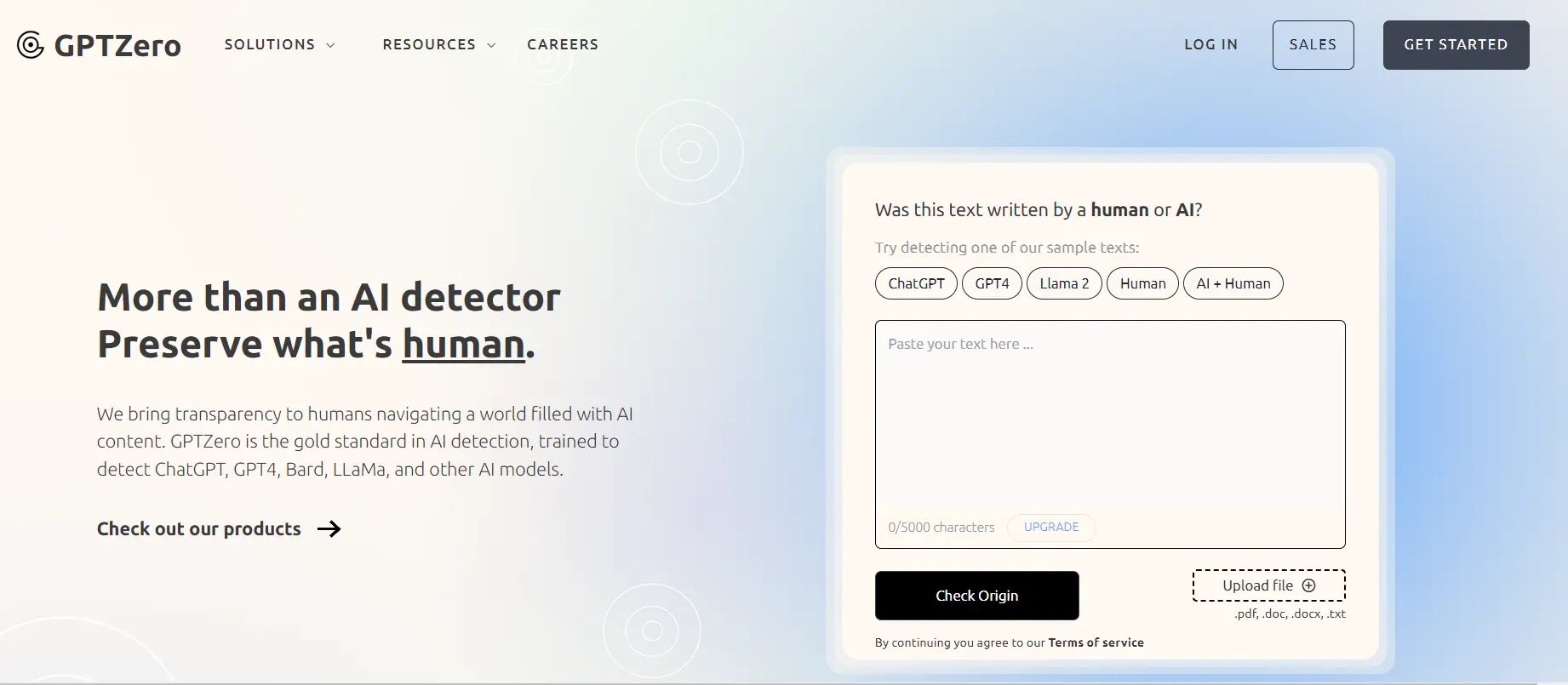
GPTZero is one of the most widely used AI content detection tools, built specifically to identify text generated by AI models like ChatGPT, GPT-4, Claude, Bard, LLaMA, and others. Created by Princeton student Edward Tian in January 2023 and rapidly adopted by educators worldwide, GPTZero has evolved into a comprehensive platform used by universities, publishers, legal professionals, and organizations that need to verify the origin of written content.
What GPTZero Does
GPTZero analyzes text — whether pasted directly or uploaded as a document — and produces a detailed report assessing the probability that the content was generated by AI versus written by a human. The system uses multiple detection methods simultaneously to minimize false positives while maintaining high detection accuracy.
The analysis produces:
- An overall AI probability score (percentage likelihood of AI generation)
- Sentence-level highlighting showing which specific sentences appear more AI-generated
- A detailed report explaining the factors contributing to the assessment
- Document statistics and writing pattern analysis
This multi-layer output makes GPTZero more informative than simple binary (AI/not-AI) detectors.
Key Features and Tools
AI Detection Engine
GPTZero’s core detection model uses a multi-component approach — rather than a single detection signal, it evaluates text across seven distinct dimensions simultaneously. This is why it achieves higher accuracy with lower false positive rates than simpler single-dimension detectors.
The model is specifically fine-tuned for:
- Academic writing — understanding the conventions and patterns of student essays, research papers, and academic prose
- Longer documents — accuracy increases with text length; GPTZero performs best on document-level analysis (1000+ words) rather than short fragments
- Multiple AI models — detecting content from GPT-2, GPT-3, GPT-3.5, GPT-4, Claude, Bard/Gemini, LLaMA, and other widely-used models
Origin Chrome Extension
The Origin browser extension integrates GPTZero’s detection capabilities directly into your web browser — enabling real-time detection of AI-generated content on any webpage you visit. This is useful for educators reviewing student submissions in learning management systems, publishers reviewing submitted work, and anyone who wants quick AI content checks without switching applications.
Writing Report
The Writing Report feature provides a behind-the-scenes analysis of Google Docs documents. It tracks the writing process timeline — when content was added, in what order, and at what pace — providing additional context about whether a document was written organically or produced in an unusual pattern consistent with AI generation and paste-in.
This feature is particularly valuable for educators who want to understand the writing process, not just the final output.
AI Detection API
GPTZero offers a developer API that enables integration of its detection capabilities into existing tools, platforms, and workflows. Organizations can use the API to:
- Automate screening of submitted content at scale
- Integrate AI detection into LMS (learning management systems)
- Build custom workflows that flag potential AI content for human review
- Process batch submissions programmatically
The API has been adopted by educational institutions, publishers, and compliance-sensitive organizations that need systematic AI content detection at scale.
Batch Upload and Processing
Premium tiers support batch document upload — enabling simultaneous processing of many documents rather than manual one-at-a-time submission. This is essential for educators grading class assignments, publishers processing manuscript submissions, or organizations screening large content archives.
Sentence-Level Highlighting
One of GPTZero’s most useful features for educators is sentence-level highlighting — the analysis color-codes individual sentences by their AI probability, making it easy to identify which specific portions of a document appear AI-generated even when the overall document contains mixed human and AI writing.
This nuance matters: many students use AI to write specific paragraphs while writing other sections themselves. Sentence-level analysis surfaces this pattern in ways that document-level scoring alone doesn’t.
How Accurate is GPTZero?
Accuracy in AI detection is a technically complex topic, and GPTZero’s creators are notably transparent about this. Key accuracy considerations:
Where GPTZero performs well:
- Documents with 1000+ words of primarily AI-generated content
- Academic prose written in the style common in training data
- Content generated by widely-used models (GPT-3.5, GPT-4, Claude)
- English-language text
Where accuracy decreases:
- Very short text fragments (under 250 words)
- Heavily edited AI content (significant human editing reduces AI signals)
- Non-English languages
- Human writing that stylistically resembles AI output (formal, structured writing)
- AI content that’s been deliberately obfuscated
GPTZero provides probability scores rather than binary determinations — this is intentional. The creators explicitly discourage punitive use of the tool without additional evidence. It’s designed as one input into a broader assessment, not a standalone verdict.
Use Cases
Education and Academic Integrity
Education is GPTZero’s primary and largest use case. Universities and K-12 institutions use it to identify potential AI use in student assignments. The combination of document-level probability scores, sentence highlighting, and Writing Report provides educators with meaningful evidence for conversations with students — not as definitive proof, but as a starting point for dialogue.
Important note on responsible use: GPTZero’s creators emphasize that the tool should be used to initiate conversations, not impose penalties. AI detection should be one part of a broader approach to academic integrity that includes assignment design, student support, and direct conversation.
Publishing and Content Verification
Publishers, content platforms, and media organizations use GPTZero to screen submitted content for AI generation — particularly important as AI-generated content has flooded freelance platforms and submission queues. Most reputable publishers have established AI content policies; GPTZero provides an automated screening tool.
Legal and Compliance
Legal professionals use GPTZero to verify the authenticity of submitted documents and affidavits. HR departments use it in hiring processes to screen written work samples. Compliance teams in regulated industries use it to verify that human-authored documentation requirements are being met.
Content Marketing Quality Control
Content managers use GPTZero to audit content produced by freelancers or internal teams to ensure alignment with content authenticity policies — particularly relevant for brands that have committed to human-authored content as a differentiator.
Pricing
Pricing (verified March 2026):
| Plan | Price | Includes |
|---|---|---|
| Free | $0 | 10,000 words/month, basic detection |
| Essential | $14.99/month | 150,000 words, batch upload, document download |
| Premium | $23.99/month | 300,000 words, API access, priority support |
| Professional | $45.99/month | Unlimited words, team features, priority support |
The free tier is generous enough for occasional use by individual educators or content reviewers. The Essential plan is appropriate for educators processing class sets of assignments. Premium and Professional tiers serve organizations with high-volume needs or API integration requirements.
Limitations to Understand
Not a Perfect Detector
No AI detection tool is perfect. GPTZero will produce false positives (marking human writing as AI) and false negatives (missing AI-generated content). The false positive risk is particularly important for students with certain writing styles — highly structured, formal writing can sometimes score elevated AI probability even when entirely human-written.
Arms Race Dynamics
AI generation tools and AI detection tools are in an ongoing technical arms race. As AI writing improves, detection becomes harder. As detection improves, AI tools adjust. This means detection accuracy is not static.
English-Language Bias
GPTZero was trained primarily on English text and performs significantly better in English than in other languages. Organizations working in other languages should evaluate the tool’s accuracy for their specific language before relying on it.
Context Matters
The same document might score differently if it’s an academic essay vs. a business report. Context about the expected writing style is relevant to interpreting scores.
How GPTZero Compares
| Feature | GPTZero | Turnitin AI | Winston AI | Originality.ai |
|---|---|---|---|---|
| Detection models covered | ChatGPT, GPT-4, Claude, LLaMA, Bard | ChatGPT, GPT-4 | Multiple | Multiple |
| Sentence highlighting | Yes | Yes | Yes | Yes |
| Writing Report (process) | Yes | Yes (iThenticate) | No | No |
| Chrome extension | Yes | No | No | No |
| API access | Yes (Premium+) | Enterprise | Yes | Yes |
| Batch upload | Yes (Essential+) | Yes | Yes | Yes |
| Plagiarism detection | No | Yes (core) | No | Yes |
| Price | Free/$15-46/mo | Institutional | $18+/mo | $14.95+/mo |
| Best for | Education/content | Education | Content | Content/SEO |
GPTZero’s primary differentiation versus alternatives is its educator-specific features (Writing Report, Google Docs integration), its sentence-level analysis, and its transparent approach to accuracy claims. For academic use cases, it’s the most purpose-built tool in the category.
Alternatives to Consider
- kleap AI — Kleap empowers users to build dynamic websites effortlessly with AI technology.
- Hocoos AI — Hocoos AI Website Builder simplifies web design with AI.
- ElevenLabs — Reshaping Voice Generation with Advanced Technology.
Related Reading
- 7 Best AI Tools for Academic Research
- AI Tools You Need in 2025 For Content Creation
- 10web.io
- Audiopen AI
Conclusion
GPTZero stands as one of the most capable and responsibly designed AI detection tools available. Its multi-component detection model, sentence-level analysis, educator-specific features, and transparent communication about accuracy limitations make it the leading choice for academic integrity use cases.
The tool is most valuable as part of a broader approach to AI content policy — not as a standalone verdict machine. When used with appropriate context, calibrated expectations about accuracy, and a commitment to using findings as conversation starters rather than punishments, GPTZero provides meaningful signal that would otherwise be invisible.
For educators, the free and Essential tiers are accessible enough that there’s minimal cost barrier to incorporating AI detection into academic integrity workflows. For organizations with higher-volume needs, the API and batch processing capabilities scale effectively.